The assertion that pro-Palestinian street mobilisation in European cities is organised and financed by Qatar and Turkey is usually made without reference to what open sources can and cannot establish. That is a mistake, because the open-source record on this question is unusually strong at one end of the chain and essentially empty at the other, and the shape of that asymmetry is itself analytically informative.
This assessment separates three things: the documented financing of European Islamist institutional infrastructure, the undocumented link between that infrastructure and specific demonstrations, and the collection approach that would close the gap.
The Documentary Base Is Primary-Source Grade
Financing of European Muslim Brotherhood-aligned institutions by Qatar rests on captured internal documentation rather than inference. The Chesnot and Malbrunot corpus consists of bank transfers, cheques and official correspondence covering roughly ninety million euros distributed across Europe, with the substantial majority flowing to Brotherhood-affiliated projects and routed through Qatar Charity and the office of the former emir. Documentary provenance of this quality is rare in influence-operations research. It does not require an analyst to accept a source’s characterisation of intent, because the disbursement records establish the recipient set directly.
The French state subsequently corroborated the network picture from its own holdings. The Interior Ministry assessment released in May 2025 described a sustained entryist strategy directed at schools, local government and public institutions, and identified Qatar and Turkey as the principal external backers of the European networks conducting it. A parliamentary commission reporting later that year extended the finding, characterising the operating pattern as dissimulation, double discourse and victimisation, and describing municipal-scale ecosystems in Lyon, Marseille and the northern departments. Neither document originated with a party hostile to Muslim political participation in France, which raises rather than lowers their evidentiary weight.
Turkish financing requires no reconstruction at all, because it is administered openly by a ministry. The Diyanet appoints imams to mosques in France, Germany, Austria and the Netherlands, pays them from the Turkish budget, and issues the Friday sermon centrally. Postings, budgets and sermon texts are published. This is the most transparent state-directed religious influence programme operating in Europe and the least analytically contested.
The cadre-formation layer is likewise documented. FEMYSO, the federation supplying organisational leadership across European Muslim youth structures and holding consultative access in Brussels, has been assessed by French intelligence as the youth arm of the Council of European Muslims and as a training platform for Brotherhood-track figures, receiving in excess of one million euros annually from Qatar since 2016.
The Gap Is Real and Structural
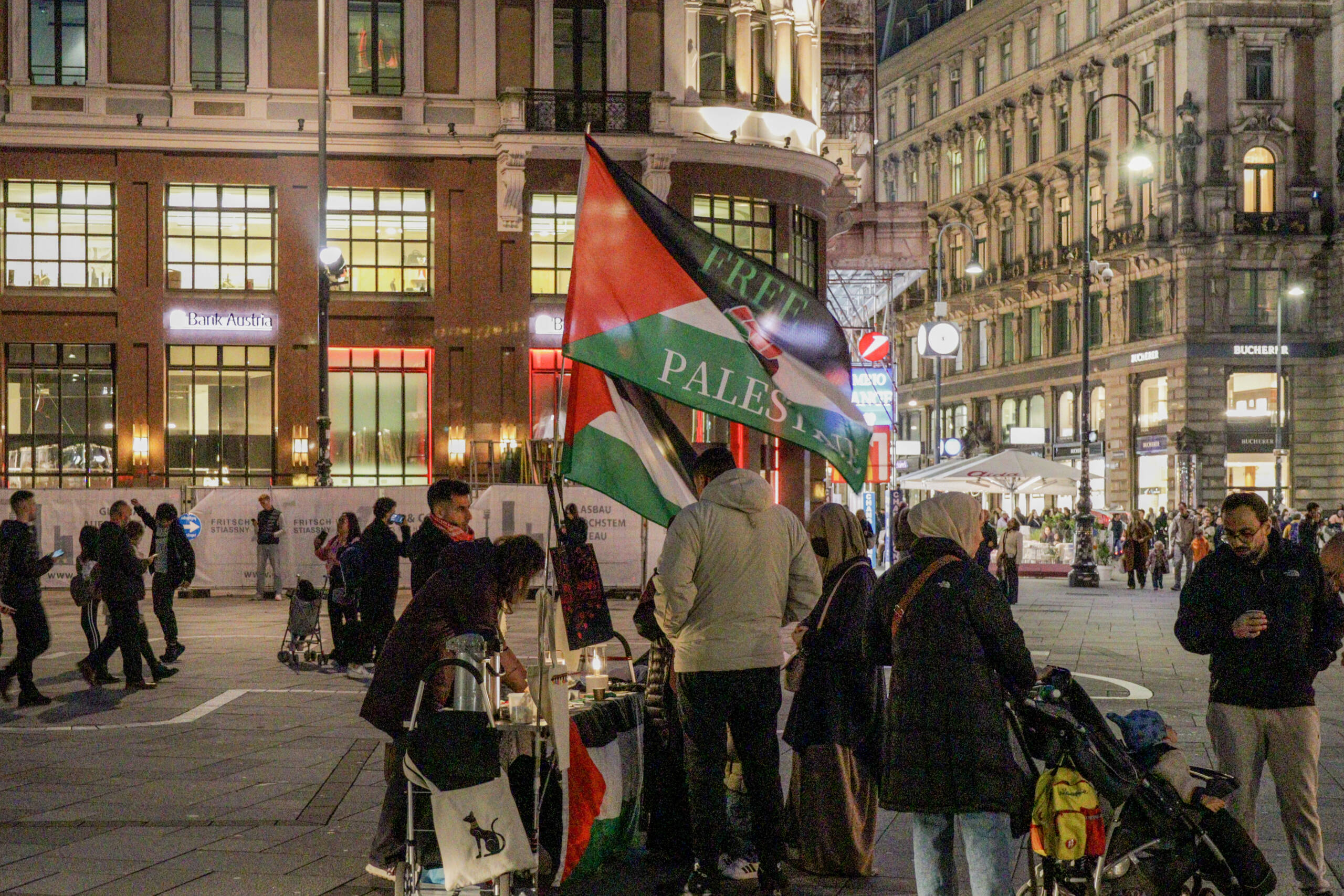
No open source establishes a financial path from Doha or Ankara to the organisation of a specific demonstration in Vienna, Berlin or Paris. Analysts sympathetic to the funding thesis concede this directly. Reporting on the American campus protests, which received far more forensic attention than the European street events, stated plainly that no direct paper trail between particular protests and foreign state interests had surfaced.
What the collection does show, consistently across jurisdictions, is domestic conveners. Israeli institutional analysis of the post-October 2023 European demonstrations attributes organisation to local Palestinian community associations operating alongside radical left, anti-government and anarchist formations. Assessments of the western European wave describe the same red-green configuration: Western far-left groups working with PFLP-aligned organisations and political Islamist bodies. Where European states have moved to proscribe, as in the German bans on Samidoun and Palästina Solidarität Duisburg, the stated grounds concerned Palestinian factional linkage rather than Gulf or Turkish state financing.
The gap should not be read as exculpatory, and the reason is methodological. Influence architectures that require per-event disbursement are inefficient and expose themselves at every transaction. Architectures that fund formation instead — the seminary, the school curriculum, the youth federation, the mosque association board — generate downstream mobilisation capacity that is self-sustaining and financially untraceable to the original sponsor by design. Absence of a per-event trail is the expected observable of a competent programme, not evidence of its absence. It is also, unavoidably, the expected observable of no programme at all, which is why the gap has to be attacked with collection rather than argued away.
How the Gap Would Actually Be Closed
The link is testable from open sources, and it has not been seriously attempted. The tractable approach is registry work rather than financial forensics.
European demonstration permits name a responsible convener, and in most jurisdictions those filings are obtainable. German association registers, French prefectural association declarations and Austrian Vereinsregister entries disclose board composition and, in some cases, filed accounts. FEMYSO publishes its member organisation list. Diyanet postings are published by mosque. The analytical product is a name-overlap matrix: cross-reference the individuals named on demonstration permits and convening-coalition statements against the boards of Qatar-funded institutions, the FEMYSO membership, and Diyanet-administered mosque associations in the same city.
If the funding thesis holds, that matrix will show non-random overlap that scales with the funded institutional density of a given city. If it does not hold, conveners will resolve overwhelmingly to solidarity committees, student unions and left parties with no board-level intersection, and the funded institutions will appear as endorsers rather than organisers. Both outcomes are informative, and the test is cheap.
Alternative Hypotheses
Two competing explanations account for the same observables and must be carried.
The first is that European protest mobilisation is genuinely endogenous and the funded institutions are incidental to it. Turnout figures support this reading more than any other single data point. The October 2025 Madrid march drew approximately half a million and Barcelona three hundred thousand, mobilised through BDS chapters, student organisations, feminist collectives and grassroots unions in a country where the funded Islamist institutional layer is comparatively thin. No plausible funding model produces that from Doha, and analysts asserting one are working backwards from the conclusion.
The second is sponsor competition rather than sponsor coordination. Qatari, Turkish, Moroccan, Algerian and Saudi financing of European Islamic institutions has been mutually rivalrous for two decades, with Doha explicitly displacing incumbents rather than joining a common programme. A single coordinated framework is not the best explanation of a field in which the sponsors are contesting each other for the same mosques.
The defensible assessment is therefore narrower than the popular claim and better supported than its dismissal. Qatari and Turkish state financing has demonstrably built and staffed the institutional, educational and cadre-formation layer of political Islam in Europe. That layer supplies vocabulary, legitimation and organisational personnel to a protest movement whose convening apparatus is predominantly domestic and left-aligned. Whether it also supplies conveners is an open question with a specific, achievable collection answer, and until someone runs the registry overlap the confident assertions in both directions are unearned.