The tower in the middle of the frame is 30 Rockefeller Plaza. One block east, at 630 Fifth Avenue, the International Building housed a foreign intelligence service that spent five years running influence operations against the population of the country hosting it. The cover was a passport office. The landlord knew, and charged little or nothing for the space.
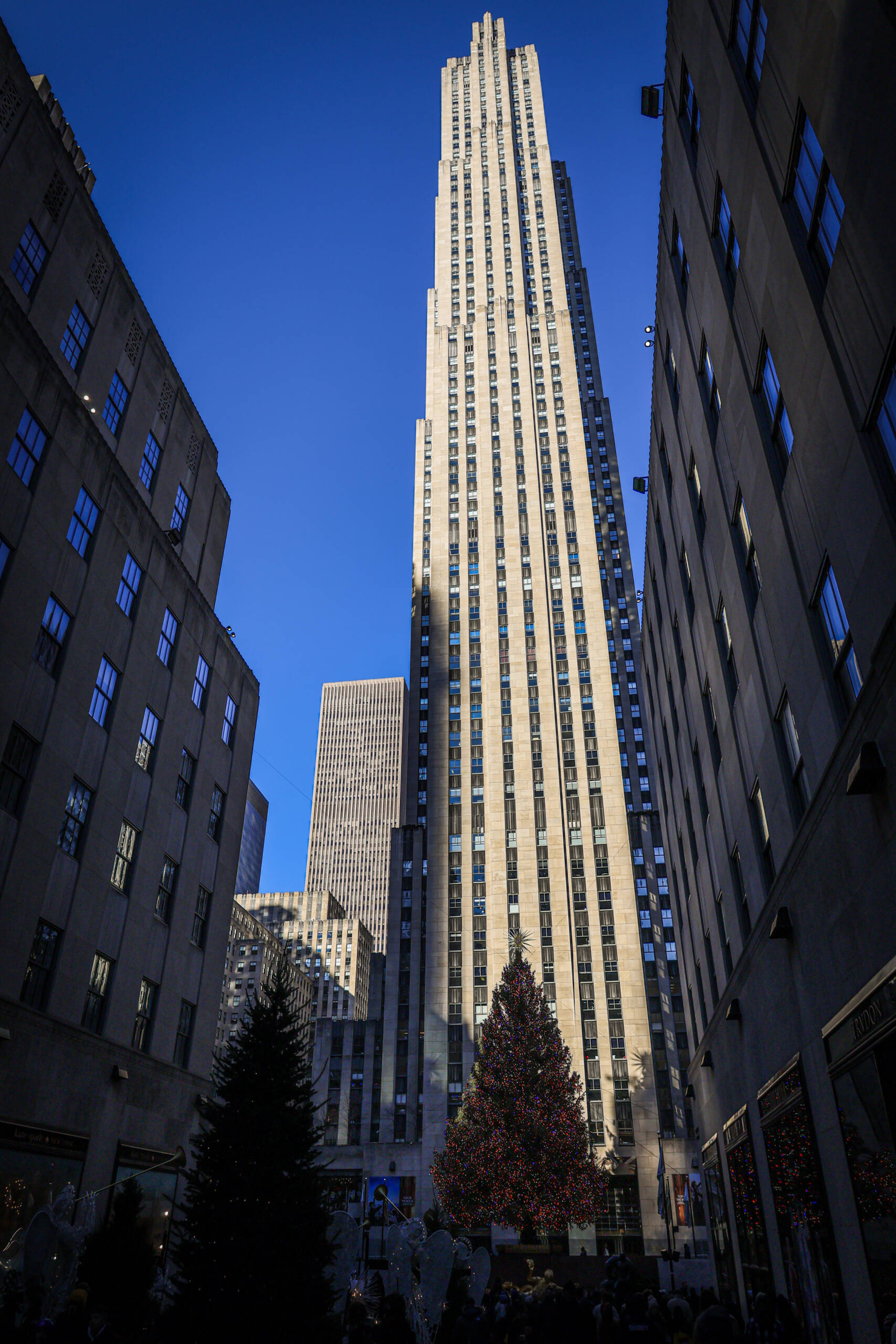
British Security Coordination was set up in May 1940 on Churchill’s authorization, with William Stephenson in charge and the Secret Intelligence Service as its parent. It started on two floors and grew to three. At its peak it ran well over a thousand staff, most of them Canadian women doing registry, cipher and secretarial work. An organization that size does not look like a passport control office, and yet the cover held for the duration.
The Problem It Was Built to Solve
In 1940 Britain needed American materiel and eventually American belligerence. The Neutrality Acts stood in the way, and so did a large bloc of public opinion that was not pro-German but was firmly against another European war. Roosevelt was sympathetic and constrained. He could not move faster than the country would let him.
BSC’s mandate covered counter-sabotage and the protection of British shipping interests across the hemisphere. That was the half that fits the standard definition of an intelligence station. The other half was political: shift American opinion far enough that the administration could act without paying for it at the polls. That is not liaison work. It is a foreign service conducting a domestic persuasion campaign inside an allied neutral, with the tacit consent of that neutral’s president.
The Method Is the Interesting Part
The operational pattern is worth studying because it is still in use, with different delivery systems.
BSC did not broadcast at Americans. It fed material into American outlets and let the American press ecosystem do the distribution. Placed stories went into friendly newspapers and radio, were picked up as legitimate reporting by other outlets, and reached the public with no visible foreign fingerprint. Sympathetic columnists received usable copy. Isolationist figures and organizations were investigated, embarrassed and discredited with information whose origin was never traceable back to a British office in Manhattan. Polling was commissioned and results were shaped and released to create the impression of a public already moving.
Fabricated documents were part of the toolkit, including material purporting to show German designs on South America that made its way into a presidential speech. The point is the architecture, not any single forgery. Origin was severed from the message before the message reached the audience, so the audience judged it on the credibility of the American outlet carrying it. Modern analysts call this narrative laundering and treat it as a novel feature of the information environment. It was standing practice on the 36th floor in 1941.
American Intelligence Grew Up in the Same Complex
The FBI opened its own cover office at 30 Rockefeller Plaza in August 1940, running the new Special Intelligence Service out of a room registered to a fictitious trading company. Its beat was Axis espionage, sabotage and propaganda in Latin America, which is to say the first sustained American civilian foreign intelligence effort. Nelson Rockefeller’s Office of the Coordinator of Inter-American Affairs, also headquartered in the complex, provided cover for some of that work.
Stephenson had known William Donovan since the previous war and cultivated him deliberately. Donovan’s 1940 and 1941 trips to London, arranged with British help, produced the argument for a centralized American service. He became Coordinator of Information in July 1941 and head of the Office of Strategic Services in 1942. Early OSS officers trained at a facility BSC ran in Ontario. Allen Dulles worked out of the same New York complex before going to Bern.
So the lineage runs through a few floors of commercial office space: a British station teaching an American one how to do the job, in a building leased by a family with its own stake in the outcome, three blocks from Radio City. The Christmas tree was already an annual fixture by then.
Why This Belongs in an OSINT File
Three things carry forward.
Commercial real estate is durable cover. A named tenant, a plausible business, a lease and a switchboard beat any legend built on paperwork alone. That principle did not expire in 1945.
Volume defeats secrecy less often than people assume. A thousand staff kept a passport-office cover for five years because nobody outside had a reason to count, and because the surrounding building was full of legitimate international tenants doing legitimate international business.
And the influence playbook that dominates current threat reporting is not a product of social platforms. Platforms changed the throughput and the cost. The method was already mature when it needed a newspaper wire and a friendly editor to work.
The tourists in the plaza are photographing a tree. The interesting building is the one behind them.